

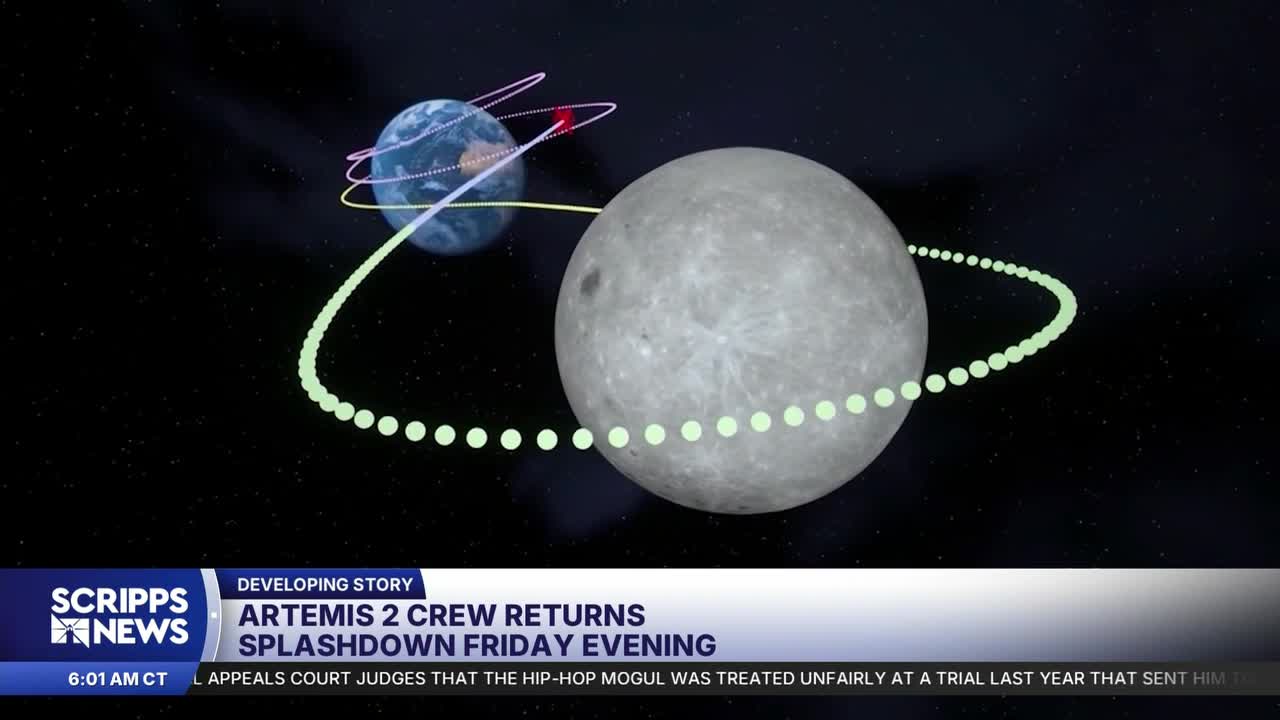


With the moon at their backs, the Artemis II crew is preparing for its return to Earth on Friday after becoming the first humans in more than 50 years to venture around the moon.
The four astronauts traveled farther from Earth than any humans have ever gone. They captured striking images of the moon, Earth and the galaxy while studying for potential future missions to the moon and beyond.
NASA is targeting an 8:07 p.m. Eastern time splashdown of the crew’s Orion spacecraft. Before reentry, the crew will pressurize their spacesuits and lower their visors to protect themselves from the intense heat generated during descent.
RELATED STORY | Artemis II mission completes successful transit around the far side of the moon
Rick Henfling, NASA’s flight director for Artemis II, said ground crews are monitoring wave conditions, winds and precipitation. As of late Wednesday, he said, “We have some really favorable conditions.”
NASA said Orion is capable of landing even if it experiences multiple contingencies, but flight controllers will still monitor its mechanics before splashdown.
“We’re really looking at things that affect guidance, navigation and control, and the propulsion systems,” Henfling said. “We want to ensure that the spacecraft can still fly safely home. We have some ways to alter the landing profile, which shortens our entry path.”
On the uncrewed Artemis I mission, NASA discovered significant issues with Orion’s heat shield. Rather than burning away in a controlled manner, the shield had more layers and pieces that were charred and cracked than expected.
NASA adjusted how it applies the heat shield material to Orion as a result of the excessive charring. The spacecraft will also reenter Earth’s atmosphere in a different way.
RELATED STORY | What Artemis II astronauts eat: NASA space menu for moon mission
Artemis I used a “skip” reentry, bouncing in and out of the atmosphere before landing. Artemis II will take a more direct path to its splashdown site.
Mission controllers say they lose some flexibility in potential landing zones with the lofted entry approach, but Orion program manager Debbie Korth stressed that changing the reentry method was part of the plan well before launch.
NASA also tests the tiles surrounding Orion for damage, specifically from tiny bits of debris in space.
“We really didn’t see anything (concerning),” Korth said.
