

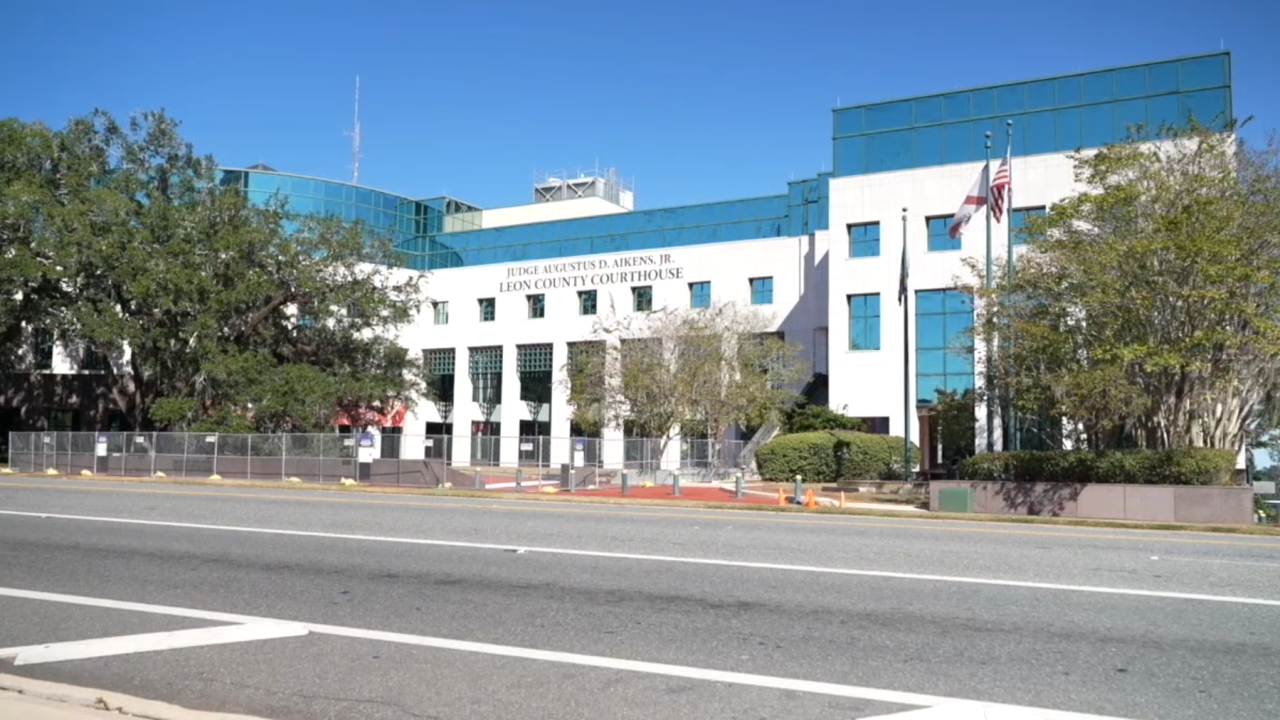


TALLAHASSEE, Fla. (WTXL) — A Leon County judge has ordered Florida to rewrite the ballot language for Amendment 3, ruling that the Legislature’s description of its sweeping property-tax proposal is biased, inaccurate and misleading.
Watch Forrest Saunders' previous report on the court case:
First reported by Florida Politics, Circuit Judge David Frank granted summary judgment to the challengers Monday night, declared the current title and summary “clearly and conclusively defective” and blocked Secretary of State Cord Byrd from placing that wording on the November ballot.
Frank ordered Attorney General James Uthmeier to submit corrected language to the Department of State within 10 days. Read the full ruling.
The decision does not remove Amendment 3 itself from the ballot. Frank stressed that the court is not deciding whether the property-tax plan is good policy, only whether voters are receiving a fair and accurate explanation before making that decision.
“They fail both prerequisites and must be rewritten,” Frank wrote.
Judge calls title a political slogan
Three consolidated lawsuits challenged the title “Save Our Homes From Excessive Property Taxes” and a summary promising to benefit taxpayers, protect small businesses, preserve core services and ensure fairness.
Frank agreed that the title resembles campaign messaging more than a neutral description.
“The title is more akin to a political slogan,” he wrote. “It is not fair or neutral. It advocates a policy position: to stop excessive property taxes.”
The judge found the word “save” was designed to provoke an emotional response. He also ruled that invoking “Save Our Homes” could confuse voters because that name is already commonly associated with Florida’s existing 3% cap on annual assessment increases for homesteaded property.
Amendment 3 would not change that cap.
Frank further found that the promise to save homes from “excessive” taxes could be misleading because the amendment does not guarantee lower overall tax bills. Cities and counties could respond to a smaller tax base by raising millage rates or using special assessments, potentially offsetting some homeowners’ savings.
Renters could also face higher costs if landlords pass along increased taxes, Frank wrote.
“Simply put, the proposed ballot title does not state the basic legal purpose of the amendment; it endorses it and diverts voters from its actual effect,” the ruling states.
Court finds errors throughout summary
The ruling directs Uthmeier to remove the summary’s opening declaration that the amendment “benefits Florida taxpayers” and four promotional taglines:
“Exempting homestead properties from taxation,” “Ensuring funding for core services,” “Protecting small businesses” and “Ensuring fairness for Florida residents.”
Frank found several additional problems with the description.
The summary says the amendment would exempt the first $250,000 of a homestead’s value when it takes effect in 2027. The proposal would actually set the exemption at $150,000 during 2027 before increasing it to $250,000 in 2028 and adjusting it for inflation beginning in 2029.
The court also rejected language promising a “schedule for full elimination” of non-school homestead property taxes. The amendment would instead require lawmakers to establish a procedure through which cities and counties could increase the exemption up to a home’s full assessed value. It would not require local governments to eliminate those taxes.
Frank found the promise of “ensuring funding for core services” misleading because the proposal does not guarantee a minimum funding level for police, fire rescue, infrastructure or other services. State economists estimate the measure would substantially reduce the tax revenue available to local governments.
The pledge to protect small businesses was also rejected. The amendment would reduce the annual assessment-growth cap from 10% to 5% for all non-homestead property. That includes large commercial properties, rentals and second homes — not specifically small businesses.
The judge also ruled that the summary misstates who would face a waiting period before receiving the expanded exemption. The distinction is based on whether someone was a Florida resident by Dec. 31, 2026, and when that person begins claiming a homestead exemption, not simply whether residency was established after Jan. 1, 2027.
Finally, Frank found the summary failed to disclose a potentially significant shift in government authority. The proposal would place language in the Constitution allowing the Legislature to control how cities and counties spend property-tax revenue, an alteration to local home-rule powers the judge said voters should be told about.
Ruling follows heated hearing
The decision largely adopts arguments made during a July 29 hearing by plaintiffs including the nonprofit Save Our Voters From Misleading Ballot Language, several former mayors, former Republican state Sen. Jeff Brandes and former Democratic U.S. Rep. Al Lawson Jr.
“This is probably the worst example of a biased ballot question and an inaccurate ballot question that we’ve seen,” plaintiffs’ attorney Jamie Cole told Frank. “This is really just a political campaign flyer.”
State attorneys had argued that the title and summary must be considered together and are required to describe only the amendment’s chief purpose—not every possible fiscal or policy consequence.
“The summary is supposed to be written for voters, not for lawyers,” state attorney Ben Gibson said during the hearing.
Frank ultimately sided with the plaintiffs, rejecting the state’s request for summary judgment.
Attorney general gets a roadmap
The ruling provides suggested language for several portions of the replacement summary.
Frank said the new wording should clearly state that the non-school homestead exemption would increase to $150,000 in 2027 and $250,000 in 2028. It should describe the reduction of the non-homestead assessment cap from 10% to 5%, accurately explain the residency distinction and include the full range of permitted local-government expenditures.
The attorney general is not required to use Frank’s examples word for word, but the replacement must correct each deficiency identified in the order.
The court will retain jurisdiction over the rewrite. Any challenge to Uthmeier’s replacement language must be filed within 10 days after it is submitted to the Department of State.
The order is final for purposes of an appeal, meaning the state can ask a higher court to reverse Frank’s decision. County election officials may begin printing ballots Aug. 27, leaving a compressed timeline for any rewrite, renewed challenge or appeal.
What Amendment 3 would do
The Legislature approved Amendment 3 during a June special session called by Gov. Ron DeSantis.
For people who establish permanent Florida residency by Dec. 31, the proposal would increase the non-school homestead exemption to $150,000 in 2027 and $250,000 in 2028. School district property taxes would remain unaffected.
The measure would also reduce the assessment-growth cap for non-homestead property from 10% to 5%, establish a waiting period for newer residents and place constitutional language around how cities and counties spend property-tax revenue.
Florida’s Revenue Estimating Conference projected the quantifiable portions would reduce local property-tax collections by nearly $4.93 billion in the 2027-28 fiscal year. The modeled recurring impact is approximately $11.83 billion annually. Read the state fiscal analysis.
Amendment 3 requires support from at least 60% of voters to pass in November.
Want to see more local news? Visit the WTXL ABC 27 Website.
Stay in touch with us anywhere, anytime.
