



TALLAHASSEE, Fla. — Florida’s sweeping property-tax amendment remains headed to voters—but the sales pitch lawmakers wrote for the November ballot does not.
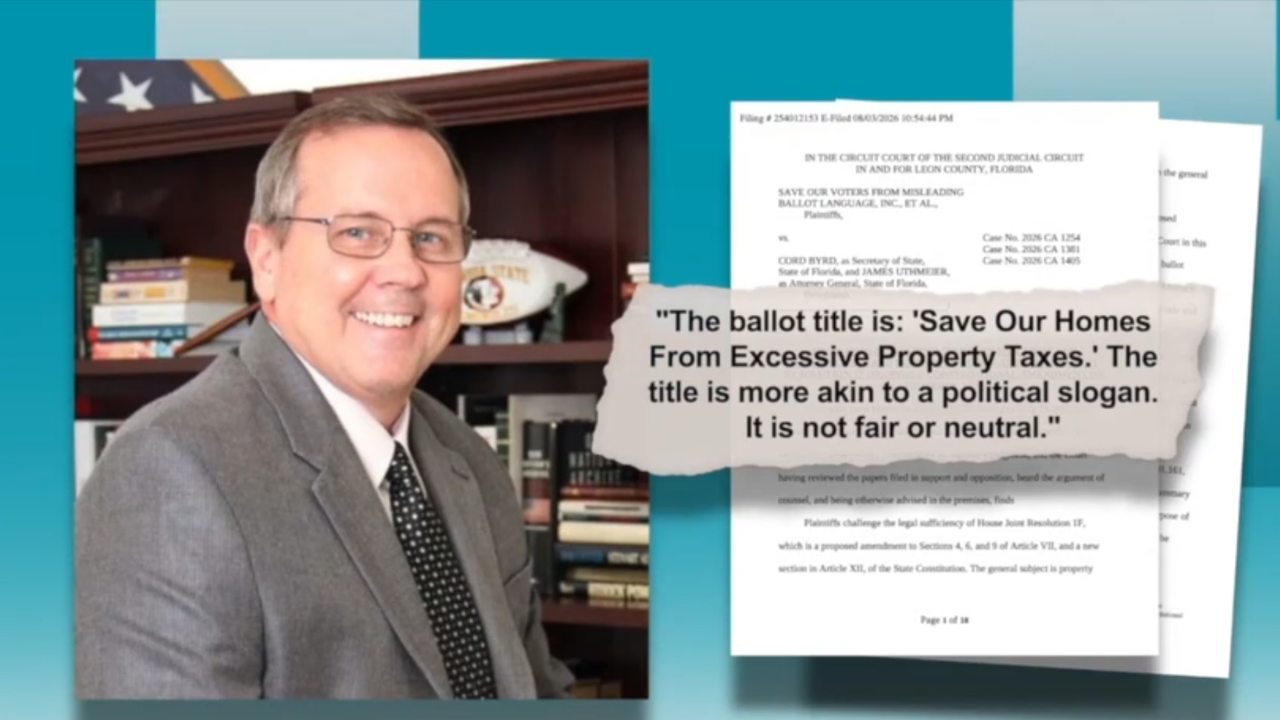
Leon County Circuit Judge David Frank ruled late Monday that Amendment 3’s title and summary are biased, misleading and, in several places, factually inaccurate. He blocked the current wording and ordered Attorney General James Uthmeier to rewrite it.
“The title and summary simply must pass muster under longstanding Florida law that demands fairness and accuracy,” Frank wrote in the 18-page order. “They fail both prerequisites and must be rewritten.”
The ruling does not remove Amendment 3 from the ballot or decide whether the proposed property-tax changes are good policy. It changes what voters will read before making that decision.
Sponsor anticipated a court challenge
Lawmakers approved the amendment during a June special session, passing it 75-26 in the House and 30-9 in the Senate, according to the Florida Legislature’s vote history.
Even then, House sponsor Rep. Toby Overdorf, R-Stuart, acknowledged its legal future was uncertain.
Asked June 2 whether the amendment would survive a court challenge, Overdorf responded, “That remains to be seen.”
Two months later, Frank found the ballot title and summary “clearly and conclusively defective.”
Judge calls title a political slogan
The current ballot title is “Save Our Homes From Excessive Property Taxes.” Frank concluded it sounded more like campaign messaging than a neutral description.
“The title is more akin to a political slogan,” he wrote. “It is not fair or neutral. It advocates a policy position: to stop excessive property taxes.”
Frank said the word “save” was designed to provoke an emotional response. He also found that “Save Our Homes” could confuse voters because the phrase is already associated with Florida’s existing 3% cap on annual assessment increases for homesteaded property.
Amendment 3 would not change that cap.
The judge also found the title could falsely suggest the amendment guarantees lower overall property-tax bills. Local governments could respond to a smaller tax base by raising millage rates or adopting special assessments, potentially offsetting some homeowners’ savings. Renters could also face higher costs if landlords pass along increased taxes.
“Simply put, the proposed ballot title does not state the basic legal purpose of the amendment; it endorses it and diverts voters from its actual effect,” Frank wrote.
Court finds promotional and inaccurate claims
Frank also rejected the summary’s declaration that the amendment “benefits Florida taxpayers” and its promotional labels promising to protect small businesses, ensure funding for core services and guarantee fairness.
“The purpose of a ballot summary is to explain what an amendment would do, not to advocate for its adoption,” he wrote.
Among the specific problems identified in the ruling:
- The summary promises a $250,000 homestead exemption while saying the amendment takes effect in 2027. The exemption would initially be $150,000 in 2027 before increasing to $250,000 in 2028.
- It refers to protecting “small businesses,” although the lower assessment-growth cap would apply to all non-homestead property—not only small businesses.
- It says the amendment requires a schedule for the “full elimination” of non-school homestead property taxes. Frank found the proposal would instead create a process allowing local governments to increase exemptions up to a property’s full assessed value.
- It promises to “ensure” funding for core services, even though the amendment would substantially reduce the local property-tax base and does not guarantee funding for police, firefighters, infrastructure or other services.
- It inaccurately describes which new Florida residents would face a waiting period before receiving the expanded homestead exemption
“Voters are entitled to a fair, clear, accurate and non-misleading ballot statement,” Frank wrote.
Brandes calls ruling a victory for voters
Former Republican state Sen. Jeff Brandes, one of the plaintiffs challenging the language, called the decision “a victory for Florida voters.”
“The judge came out and frankly said that you can’t have advocacy on the ballot,” Brandes said.
Brandes described the amendment as a rushed, “back-of-the-napkin proposal” that “was not ready for prime time.”
He compared the current summary to an advertisement that lists a product’s benefits without disclosing its risks.
“This is like a prescription drug commercial that just tells you the benefits for 30 seconds, but then doesn’t tell you the side effects of this medication,” Brandes said.
Attorneys for the state had argued that the title and summary should be read together and that the wording needed only to explain the amendment’s chief purpose in terms understandable to ordinary voters.
“The summary is supposed to be written for voters, not for lawyers,” state attorney Ben Gibson argued during last week’s hearing.
Frank was not persuaded.
Attorney general reviewing next step
Frank ordered Uthmeier to submit revised language to the Department of State within 10 days. The court will retain jurisdiction, and challengers will have 10 days after the replacement language is submitted to raise new objections.
The state could also appeal.
“The ball is in the Attorney General’s court at this point,” plaintiffs’ attorney Jamie Cole said. “They can either appeal this decision, or have the Attorney General fix the language.”
Uthmeier said Tuesday that his office had not decided how it would proceed.
“The team is looking at that,” Uthmeier said. “This just came down. We got it this morning. So, we’re giving it a hard look, and we’ll have updates soon.”
What Amendment 3 would do
If approved, Amendment 3 would increase the homestead exemption for non-school property taxes from the typical $50,000 to $150,000 in 2027 and $250,000 in 2028. The exemption would rise with inflation beginning in 2029.
School-district property taxes would remain unchanged.
The amendment would also lower the annual assessment-growth cap on non-homestead property from 10% to 5%, impose a waiting period before certain new Florida residents could receive the expanded exemption and limit how counties and cities use remaining property-tax revenue.
A Florida House analysis estimates the amendment would reduce local non-school property-tax revenue by $4.95 billion during its first fiscal year and $8.78 billion the following year. The recurring annual reduction is projected to reach $11.86 billion once fully implemented.
Polling shows language could determine outcome
Amendment 3 needs support from at least 60% of voters to become part of the Florida Constitution.
A July University of North Florida poll found 61% initially supported the amendment—barely enough for passage—when respondents were told it would reserve property-tax revenue for core services.
Support fell to 45%, with 47% opposed, after respondents were told about projected local-government budget losses.
The poll surveyed 848 likely midterm voters from July 8 through July 17 and had a margin of error of plus or minus 3.8 percentage points.
The results underscore the stakes of the court-ordered rewrite: Amendment 3 will still be decided by Florida voters, but the words they see on the ballot could help decide its fate.
Share Your Story with Forrest

Capitol Reporter Forrest Saunders is dedicated to sharing your voice with political leaders throughout the state. He works to hold our elected leaders accountable and amplify your concerns. Let Forrest know about the issues you want state leaders to focus on.
.

Saudi flight from Tampa, secret FBI probe reveal possible Saudi support network for 9/11 hijackers
Twenty years after the Sept. 11 attacks, more than 80,000 records compiled by the Tampa FBI Field Office remain classified. Newly declassified documents are pointing to a possible secret Saudi support network for the hijackers. Soon after the attacks, the FBI uncovered that 15 of the 19 hijackers were from Saudi Arabia.
