

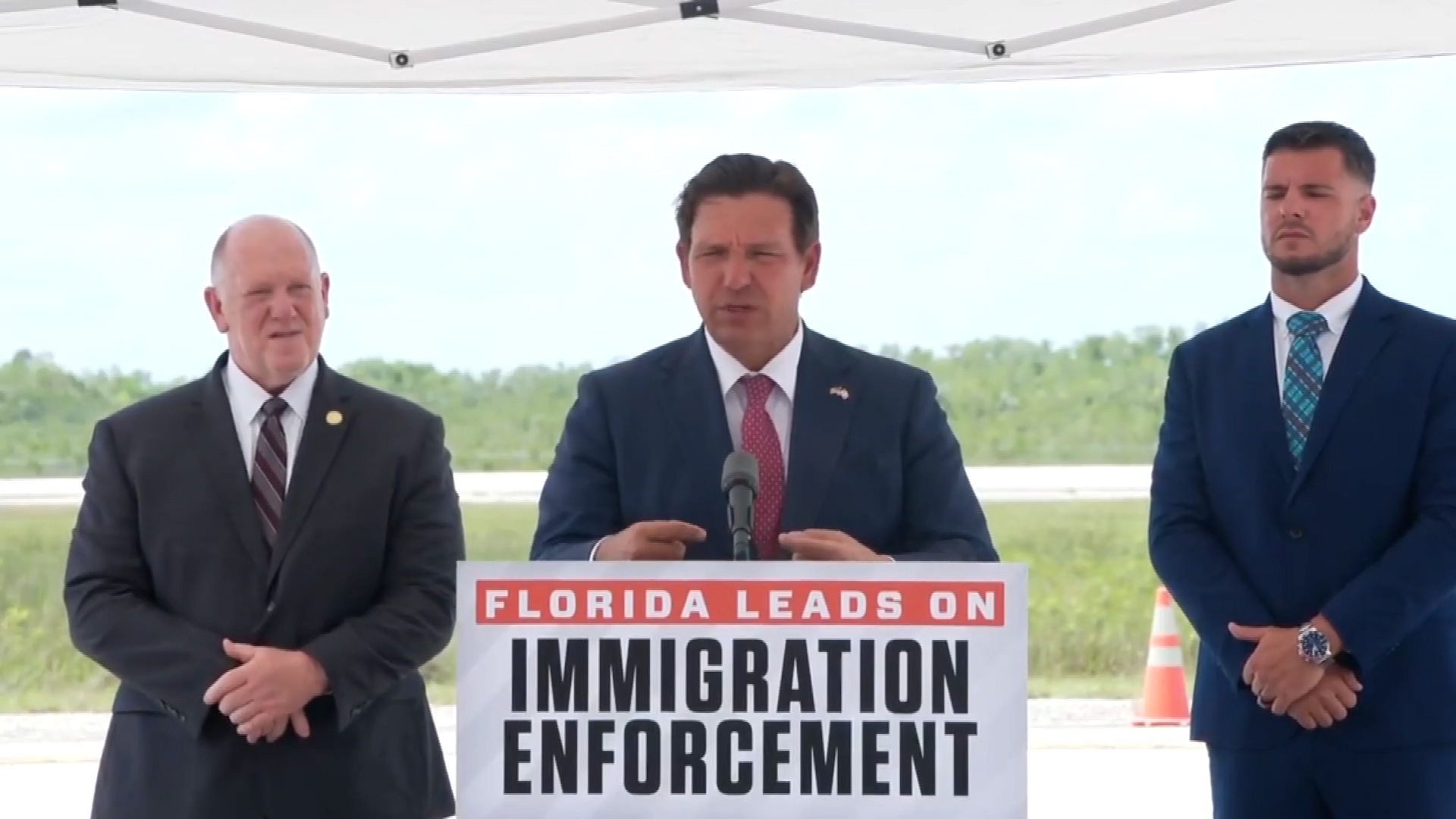


TALLAHASSEE, Fla. — “Alligator Alcatraz” is officially winding down as an immigration detention site, but the political, legal and environmental fight surrounding the Everglades facility is far from over.
Gov. Ron DeSantis and White House border czar Tom Homan on Thursday framed the controversial site as a temporary emergency mission accomplished.
WATCH: ‘Alligator Alcatraz’ has no detainees, but fight over funding and Everglades future grows
DeSantis said the facility now has zero detainees, that demobilization is underway and that the detainees previously held there remain in federal custody.
“Alligator Alcatraz fulfilled the role that it was designed to serve,” DeSantis said.
The governor said the state stood up the facility last summer because the federal government lacked enough detention space during a ramp-up in immigration enforcement. He said the site helped lead to nearly 21,000 deportations and prevented people with serious criminal histories from being released back into Florida communities.
“There’s no question that this mission has made the state of Florida safer,” DeSantis said.
Homan praised Florida’s partnership with the Trump administration and said the closure of the site does not end the state’s role in immigration enforcement.
“Today doesn’t end the cooperation,” Homan said.
Florida’s Baker County immigration facility remains open, and DeSantis said the state will continue to assist with federal immigration enforcement through 287(g) agreements and other partnerships.
But critics say the next phase of the “Alligator Alcatraz” fight may be just as consequential as the detention operation itself.
Environmental groups are preparing to continue their federal lawsuit, arguing the state and federal governments still need to account for what was built, what damage was done and how the site will be restored.
Friends of the Everglades and the Center for Biological Diversity sued last year under the National Environmental Policy Act. They argued officials failed to conduct required environmental review before the facility was built at the Dade-Collier Training and Transition Airport, a county-owned site surrounded by sensitive Everglades habitat.
“It is welcome news, but the harm is continuing,” Friends of the Everglades Executive Director Eve Samples said of reports that detainees had been removed.
Samples said her group wants the site returned to the lightly used training runway that existed before the detention facility was built. She said public records obtained through separate litigation showed the project carried staggering costs, including an estimated $1.2 million per day and roughly $1.49 billion in total projected expenses.
The funding fight is now one of the biggest unresolved questions.
DeSantis said Florida expects to be reimbursed by the federal government, acknowledging that not all the money has arrived yet but insisting the state is on solid financial footing.
“We will get reimbursed,” DeSantis said.
Hector Diaz, managing partner of Your Immigration Attorney — who has represented detainees held at the facility — disputed the governor’s victory-lap framing. He said Florida taxpayers could be left with a massive bill if federal reimbursement falls short.
“The big losers in this case is the state of Florida,” Diaz said. He argued the state spent hundreds of millions of dollars on the facility while receiving only a fraction back so far.
The human impact is also ongoing. Diaz said some detainees have been moved to other facilities, including Baker County, New Mexico and Texas. He said those transfers could delay bond hearings, asylum hearings and other court dates.
“All those court dates have been pushed back,” Diaz said.
At the same time, Miami-Dade County is now laying out a different future for the land.
Mayor Daniella Levine Cava announced Thursday that her administration intends to pursue the sale and transfer of county-controlled lands at the Dade-Collier airport to the National Park Service and other Everglades restoration partners once the detention facility is decommissioned.
In a memo to county commissioners, Levine Cava said the administration will evaluate the legal process for transferring the land so it can be incorporated into Everglades restoration efforts.
“Once this facility is decommissioned, we have an opportunity to permanently protect these lands for Everglades restoration and ensure they remain protected for generations to come,” Levine Cava said. “That is the legacy we should leave.”
Her administration said a review found the airport no longer represents the best long-term use of the property because of its remote location, limited aviation value, maintenance obligations and increasing conflict with surrounding conservation lands.
The county said potential options could include conservation easements, deed restrictions, intergovernmental agreements, land exchanges or a full property transfer. Any final recommendation would still require legal, environmental, operational and financial review before returning to the Miami-Dade County Commission.
The mayor’s office also said the county’s Department of Environmental Resources Management recently attempted to inspect the property but was unable to access the site because of an ongoing security sweep. Environmental advocates said that fits a broader pattern of limited transparency.
Share Your Story with Forrest

Capitol Reporter Forrest Saunders is dedicated to sharing your voice with political leaders throughout the state. He works to hold our elected leaders accountable and amplify your concerns. Let Forrest know about the issues you want state leaders to focus on.
.

Pasco County mom of 5 takes in 3 children left without food or power whose mother faces neglect charges
Jasmine Young, a mother of 5, opened her home to three neglected girls as their mother faces child neglect charges for leaving them without food, power or water.
